scenarioHingedRigidBodyMuJoCo
Review these prerequisite examples first:
scenarioHingedRigidBody for the classic hinged-panel model.
scenarioReactionWheel for MuJoCo bodies, joints, and actuators.
This script demonstrates how to run the classic Basilisk scenarioHingedRigidBody example using MuJoCo dynamics via MJScene instead of the traditional hub-centric Basilisk C++ Module: spacecraft dynamics.
Running the Example
Use a Basilisk installation with MuJoCo support and the example dependencies
described in Install. When building from source, enable
--mujoco True. With that Python environment active, run from the repository
root:
python examples/mujoco/scenarioHingedRigidBodyMuJoCo.py
The script displays the result plots. When importing the scenario from
examples/mujoco, call run(showPlots=False) to run without displaying
windows; it still returns a dictionary of Matplotlib figures for inspection
or saving.
Model and Force Setup
The multi-body system is created programmatically as a MuJoCo XML string. It consists of a free-floating spacecraft bus (“hub”) with two solar panel rigid bodies (“panel1”, “panel2”) attached via hinge joints (“hinge1”, “hinge2”), giving the system 8 total degrees of freedom (3 translational, 3 rotational, and 2 panel hinge DOFs).
Two existing library modules and a scenario-specific burn command are added to the MuJoCo dynamics task:
MJJointPIDController computes a torsional spring-damper restoring torque for a hinge joint from its angle and angular rate, and writes the result as a
SingleActuatorMsgcommand. One instance is attached to each panel hinge to emulate panel stiffness and damping.BurnWindowForceCommand, defined in this script, publishes a fixed force in inertial frame N during the inclusive interval[burnStart, burnEnd]and zero force outside it.MJCmdForceInertialToForceAtSite converts that command from inertial frame N into the thruster site frame S using the site’s current attitude. The site is fixed to the hub and aligned with body frame B in this example. The converter handles the rotation; the burn-command module determines when thrust is requested.
The force message chain is BurnWindowForceCommand ->
MJCmdForceInertialToForceAtSite -> the MuJoCo force actuator at
thrustSite. This keeps the requested force direction fixed in inertial
space even as the spacecraft rotates.
Earth gravity is configured using NBodyGravity with a pointMassGravityModel as the central body. Gravity targets are registered manually for the hub and both panel bodies.
The spacecraft is placed on a near-circular low Earth orbit (LEO). The simulation runs for a coast phase lasting 1% of an orbit followed by a 935-second translational burn, during which the panels respond dynamically to the resulting body motion through their spring-damper hinges.
Inertial position, orbital radius, and the two panel hinge angular displacements are plotted at the end.
Illustration of Simulation Results
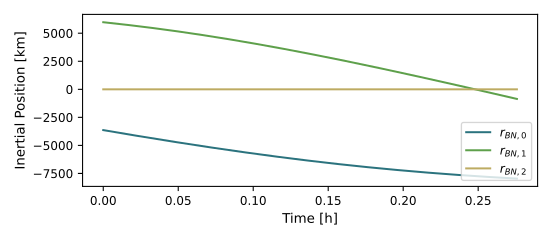
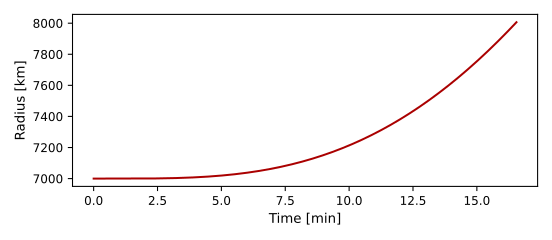
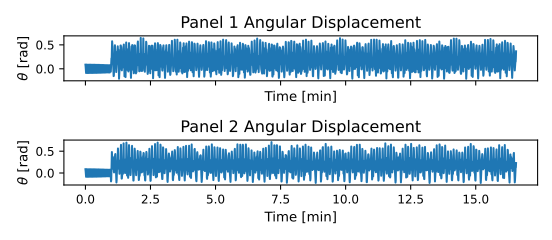
- class scenarioHingedRigidBodyMuJoCo.BurnWindowForceCommand(*args, **kwargs)[source]
Bases:
SysModelPublish an inertial force during a burn window and zero outside it.
- Parameters:
force_N – Three-component force expressed in inertial frame N [N].
burnStartNanos – Inclusive burn start time measured from simulation start [ns].
burnEndNanos – Inclusive burn end time measured from simulation start [ns].
- Variables:
cmdForceOutMsg – Commanded inertial force consumed by
MJCmdForceInertialToForceAtSitebefore reaching the actuator.
- scenarioHingedRigidBodyMuJoCo.makeMjXmlString(hubMass: float = 800.0, busIDiag: Tuple[float, float, float] = (900.0, 800.0, 600.0))[source]
Build MuJoCo XML for a spacecraft hub with two hinged panels.
- Parameters:
hubMass – Hub mass [kg]. Defaults to 800.0 kg.
busIDiag – Principal moments of inertia about the hub center of mass, ordered along the hub x, y, and z axes [kg m^2]. Defaults to
(900.0, 800.0, 600.0)kg m^2.
- Returns:
XML defining the hub, panel bodies, hinge joints, and thrust site.
- Return type:
str
- scenarioHingedRigidBodyMuJoCo.plotAngDisp(timeAxis: ndarray, panel1thetaLog: ndarray, panel2thetaLog: ndarray) Figure[source]
Plots angular displacements of panels
- scenarioHingedRigidBodyMuJoCo.plotInertialPos(timeAxis: ndarray, posData: ndarray) Figure[source]
Plot the inertial position vector components.
- scenarioHingedRigidBodyMuJoCo.plotOrbitalMotion(timeAxis: ndarray, posData: ndarray, velData: ndarray, mu: float) Figure[source]
Plots orbital motion of spacecraft
- scenarioHingedRigidBodyMuJoCo.run(showPlots: bool = False)[source]
Run a short orbital coast followed by a 935-second burn.
- Parameters:
showPlots – Display the Matplotlib figures and wait for the plot windows to close when True. Defaults to False; figures are still generated and returned in either case.
- Returns:
Dictionary mapping scenario-prefixed names to three Matplotlib figures: inertial position, orbital radius, and panel hinge angles. No files are saved by this function.
- Return type:
dict