scenarioRotTransArrayDeployment
Overview
This scenario demonstrates the multi-body prescribed motion dynamics capability of the C++ Module: prescribedMotionStateEffector module through a sequential rotational and translational solar array deployment scenario. The spacecraft in this example consists of a rigid hub and two symmetrical solar arrays. Each array is modeled as a collection of 4 prescribed motion elements. Therefore, 8 instances of the C++ Module: prescribedMotionStateEffector module are required to simulate the array deployments. Each element has a mass of 50 kg to make the hub’s rotational and translational response to the unequal deployment rates easier to see.
Note that in order to simulate hub-relative prescribed motion, kinematic profiler modules must be connected to the prescribed motion state effector modules. The kinematic profiler modules specify the translational and rotational states of each prescribed sub-component relative to the spacecraft hub and write the sub-component states at each time step to the prescribed motions state effector modules using the Basilisk messaging system. Currently two kinematic profiler modules exist in Basilisk that can be used to simulate prescribed motion. The first C++ Module: prescribedLinearTranslation module prescribes linear translational motion of a prescribed sub-component relative to the hub; while the second C++ Module: prescribedRotation1DOF module prescribes 1 DOF rotational motion relative to the hub.
The type of deployment simulated in this scenario is a 1 DOF rotational solar array deployment followed by a linear solar array deployment, therefore the C++ Module: prescribedRotation1DOF and C++ Module: prescribedLinearTranslation modules are used in this scenario to profile the array element prescribed motion. Note that 8 instances of these profiler modules are required to profile the array deployments. Also note that because only rotational motion is profiled in the first movement, PrescribedTranslationMsgPayload messages are required to be written for each array element before the translational motion is simulated and must be connected directly to the element prescribed motion state effector modules. This ensures that both the translational and rotational motion of each array element is defined relative to the hub for the entire simulation.
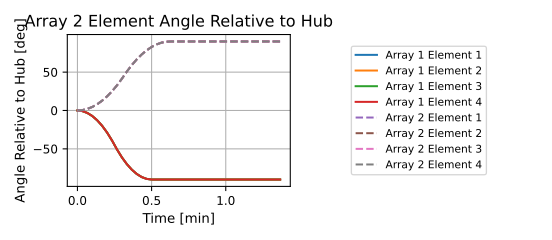
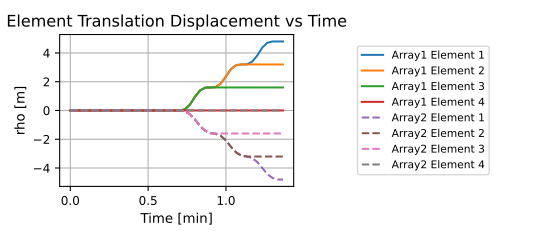
In this deployment scenario, the solar arrays on both sides of the hub begin rotating at the same time, with array 2 taking 25 percent longer than array 1. The 1 DOF rotational kinematic profiler modules prescribe a bang-bang acceleration profile for each array element. After first initializing all array elements to their stowed configuration, the elements within each array rotate together upward away from the spacecraft hub. Array 1 rotates -90 degrees about the +Y hub-frame axis in 30 seconds, while array 2 rotates 90 degrees about the +Y hub-frame axis in 37.5 seconds. After both arrays finish rotating, the elements extend in three sequential steps. Each extension step takes 10 seconds for array 1 and 12.5 seconds for array 2. Each step begins on both sides together, and the simulation waits for the slower array before advancing to the next step. The rotation and three extension steps require four simulation chunks.
The script is found in the folder basilisk/examples and executed by using:
python3 scenarioRotTransArrayDeployment.py
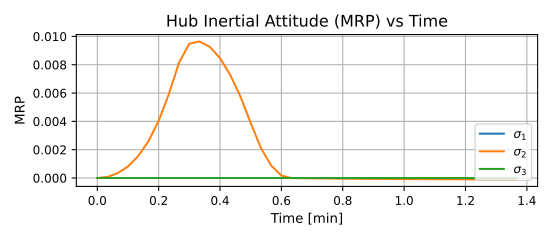
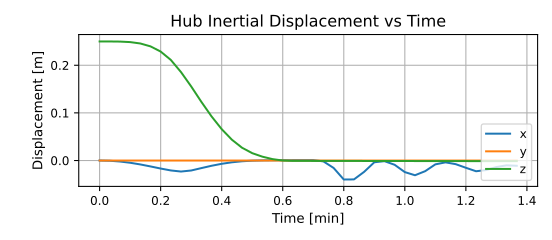
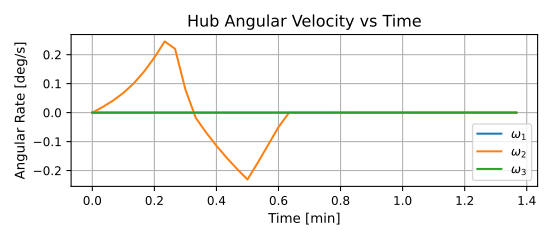
The scenario outputs five plots. The first plot illustrates the array element angles relative to the hub and the following plot illustrates the array element displacements relative to the hub. The last three plots illustrate the hub’s inertial attitude, position, and angular velocity. This scenario also creates a Vizard simulation to visualize the solar array deployment.
Vizard uses its default directional lighting. To make panel shadows easier to see, use Vizard’s Beautiful graphics
quality and a close spacecraft view. If needed, lower the ambient lighting and spacecraft shadow brightness manually
in Vizard’s settings.
Illustration of Simulation Results
The following plots illustrate the solar array deployment scenario simulation results.